Minimizing Artifact-Induced False Alarms for Seizure Detection in Wearable EEG Devices with Gradient-Boosted Tree Classifiers
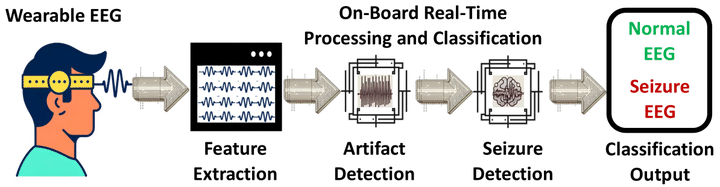 Seizure and artifact detection workflow
Abstract
Motion, muscle, and eye-blink artifacts cause false alarms in continuous seizure monitoring. This study proposes a combined seizure and artifact detection scheme using gradient-boosted decision trees tailored for wearable EEG devices with limited channels. On the CHB-MIT dataset, the subject-specific approach yields 65.27% sensitivity and 93.95% artifact-detection accuracy, reducing false alarms by up to 96% compared to standalone seizure detection. An energy-efficient implementation achieves 300-hour battery life on a wearable platform, demonstrating the feasibility of robust, long-term monitoring.
Key Highlights
- Combines seizure and artifact detection with gradient-boosted trees to reduce false alarms by up to 96%.
- Achieves 65.27% sensitivity and 93.95% artifact classification accuracy on CHB-MIT and TUH EEG Artifact datasets.
- Optimized embedded implementation enables 300-hour operation on wearable EEG hardware.

Thorir Mar Ingolfsson
Postdoctoral Researcher
Making AI run on microwatts: I build foundation models for EEG, ECG, and other biosignals, and compress them until they run in real time on wearable devices, not in the cloud.