ARNI Working Group 2026 – Foundation Models for Wearables: From EEG and EMG to Multimodal Models at the Edge
Abstract
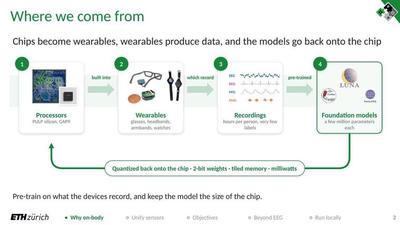
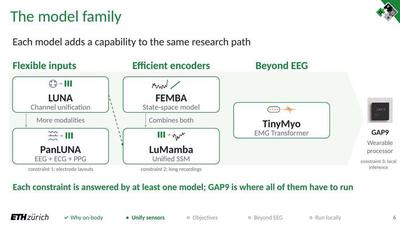
We presented an overview of the biosignal foundation models developed at ETH Zürich for wearables, organised around three constraints the device imposes on the model: electrode layouts that differ between devices, recordings that run for hours, and inference that has to happen locally within a power budget of tens of milliwatts. On the EEG side we covered LUNA, whose learned queries read any electrode montage into a fixed-size representation, and FEMBA, a bidirectional state-space encoder whose cost grows linearly with recording length, and showed how LuMamba combines the two with 26.5× fewer FLOPs than LUNA at the longest window. We then compared pre-training objectives on LuMamba, masked reconstruction against latent-space prediction with LeJEPA, and showed that the combined objective transferred best to an unseen 16-channel montage (APAVA, AUPR 0.97 against 0.77 for reconstruction alone). For EMG we presented TinyMyo, a 3.6M-parameter encoder pre-trained on public surface-EMG data that adapts to hand-gesture classification (88% on NinaPro DB5), wristband gesture decoding, hand-kinematics regression (8.8° MAE on NinaPro DB8) and silent-speech decoding (33.5% WER), together with its 1.9M-parameter variant that runs in 89 ms on GAP9. PanLUNA extended the same query mechanism to joint EEG, ECG and PPG modelling with one 5.4M-parameter encoder that matches or exceeds specialist models up to 57× larger. The last part of the talk covered what it takes to run these models on a wearable processor: none of the INT8 encoders fits the 1.5 MB on-chip memory, quantisation-aware training recovers accuracy down to 2-bit weights, and measured latencies on GAP9 range from 89 ms to 1.3 s per window. All models and code are open: the BioFoundation models have passed 40,000 downloads on Hugging Face.
An invited talk at the monthly meeting of the “Frontier Models for Neuroscience and Behavior” working group of ARNI, the NSF AI Institute for Artificial and Natural Intelligence led by Columbia University. The session was held online on 19 October 2026 (15:00 US Eastern / 21:00 Zürich) and hosted by Alexandre André of Eva Dyer’s lab at UPenn.
Talk highlights
- Three constraints, one research path: electrode layouts, long recordings and local inference as the design inputs for every model in the family.
- Objective matters for transfer: masked reconstruction plus LeJEPA latent prediction gave the best transfer to an unseen montage, with the lowest variance across seeds.
- One EMG encoder, four tasks: TinyMyo covers gestures, kinematics and speech from a single 3.6M-parameter pre-trained model, with a 1.9M-parameter variant under 100 ms on a microcontroller.
- Measured on the chip: every deployment number is a measurement on GAP9 at 370 MHz, including the finding that the model with the fewest FLOPs (FEMBA) has the longest latency.
From the slides
Slides & resources
- Download the slides (PDF) →
- BioFoundation codebase →
- Model weights on Hugging Face →
- ARNI working group speakers page →
- NeurIPS 2026 EEG/EMG Foundation Challenge → (mentioned in the talk; I co-organise the BCI track)
Related work
Thorir Mar Ingolfsson
Postdoctoral Researcher
Making AI run on microwatts: I build foundation models for EEG, ECG, and other biosignals, and compress them until they run in real time on wearable devices, not in the cloud.